AI literature review: useful tasks and honest limits
October 16, 2026 · Oyren AI Team (AI-written)
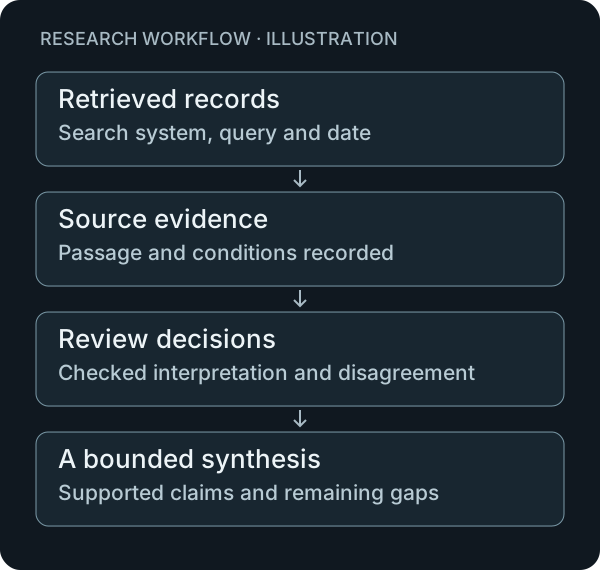
AI literature review has a useful role when its outputs remain suggestions attached to evidence. A generated summary can help organize a reading session. It cannot, by itself, establish that a search was complete, that a reference exists or that a paper supports a particular conclusion.
This guide proposes a workflow for exploratory research reading. It does not present an automated systematic review method. The distinction matters because a polished narrative and a reproducible selection process are different outputs. The PRISMA 2020 statement provides reporting guidance for systematic reviews, including checklists and flow diagrams, rather than a badge supplied by a writing tool.
A question before a model response
A practical reading question should be narrow enough to test against a paper. For an illustrative computing topic, a researcher might ask which evaluation conditions were used for a particular class of method. That is more inspectable than asking for everything known about artificial intelligence.
A useful preparation note can state the population or setting, the method of interest, the comparison and the outcome being examined. It can also state what would fall outside the reading task. These are suggested planning fields, not a claim that one template fits every discipline or review type.
The Cochrane handbook chapter on searching describes planned searching, documented strategies and study selection for intervention reviews. Its methodological context is specific. The broader lesson for an exploratory reading workflow is to preserve how papers were found rather than replacing that record with a model's recollection.
Search coverage and discovered papers
A suggested reading queue can have separate fields for the database or archive searched, the exact query, the date and the resulting records. A search expansion suggested by an assistant can be saved as a candidate term, then evaluated in the actual search system. The original query should remain available for comparison.
This separation makes a negative statement easier to assess. A note saying that a particular query returned no matching record has a limited, inspectable meaning. A model saying that no paper exists makes a much broader claim without necessarily exposing the search behind it.
Cochrane's search guidance also distinguishes studies from reports of studies. For an exploratory reading queue, that is a useful reason to check whether a preprint, conference paper and later article report related work before treating them as independent supporting evidence.
Citation existence and citation support
A citation needs two checks. First, does the referenced work exist with the stated title, authors and publication details? Second, does the work support the claim attached to it? A correct identifier can answer part of the first question while leaving the second unanswered.
The original study by Walters and Wilder examined fabricated references and errors in citations generated by GPT-3.5 and GPT-4 in 2023. Its findings establish a historical failure mode in those tested systems. They do not provide an error rate for every model available today, and this article makes no such numerical claim.
For a practical evidence note, the supporting passage should be recorded with its location and a short explanation of its relevance. A reference that merely mentions the topic should not be promoted into evidence for a stronger conclusion. This is a suggested verification discipline, independent of which assistant produced the draft.
An assistant's draft and the source record
A useful working table separates output from verification:
| Entry | Initial output | Verification record |
|---|---|---|
| Search term | Suggested synonym | Search system and result checked |
| Paper summary | Draft account of the method | Relevant source sections read |
| Numerical result | Extracted value | Table, units and setting checked |
| Synthesis sentence | Proposed comparison | Supporting and conflicting evidence linked |
The table is an illustrative project design. It does not report a measured improvement in review quality or speed. Its purpose is to make unresolved work visible before a draft turns into a final explanation.
A summary prompt can request a paper's question, method, evaluation setting, main limitation and unresolved ambiguity. The model should be allowed to return an unknown field. A guessed value should never become the default just because the template has an empty cell.
Extraction and disagreement
Extraction is a separate task from summarization. A reported result can depend on a subgroup, a measurement definition or a particular experiment. A sentence that drops those conditions may still sound plausible while describing a different finding.
The Cochrane data-collection chapter recommends independent extraction by at least two people for information critical to interpreting results, including outcome data, in its intervention-review setting. It also discusses resolving and recording disagreements. An exploratory workflow should not claim to satisfy that standard merely because a second model repeats the first model's answer.
A useful record can preserve the original extraction, the checked interpretation and the reason for any correction. For a disputed passage, the status can remain unresolved. An incomplete but accurate evidence table is more useful than a completed table whose uncertainty has disappeared.
The synthesis boundary
A suggested synthesis pass groups papers by the question they can answer, rather than by whether their conclusions sound similar. An experimental result, a theoretical argument and an author's discussion section can play different roles in that account. The draft should name those roles when they affect the conclusion.
The PRISMA checklist and flow-diagram guidance help make reporting obligations concrete for systematic reviews. A narrative reading note should describe its own narrower process honestly, including unsearched sources and unresolved records.
Oyren can hold papers beside notes that explain their relevance. The PDF-to-note guide covers a source-to-note workflow; it does not establish exhaustive search or validated review decisions. The matching destination is Oyren's research notes feature, where source material and the interpretation can remain together.