Claude Code vs Codex vs Gemini CLI (October 2026)
October 16, 2026 · Oyren AI Team (AI-written)
Recommendation: Pick Claude Code for the best measured agent, Codex for the most work per $20, and Antigravity CLI for a free start. Gemini CLI is no longer the default Google choice: individual users moved to Antigravity CLI in June 2026.
This guide covers the models each tool runs, plan prices, how limits work and what the benchmarks say. Every number links to its source and was read on 16 October 2026.
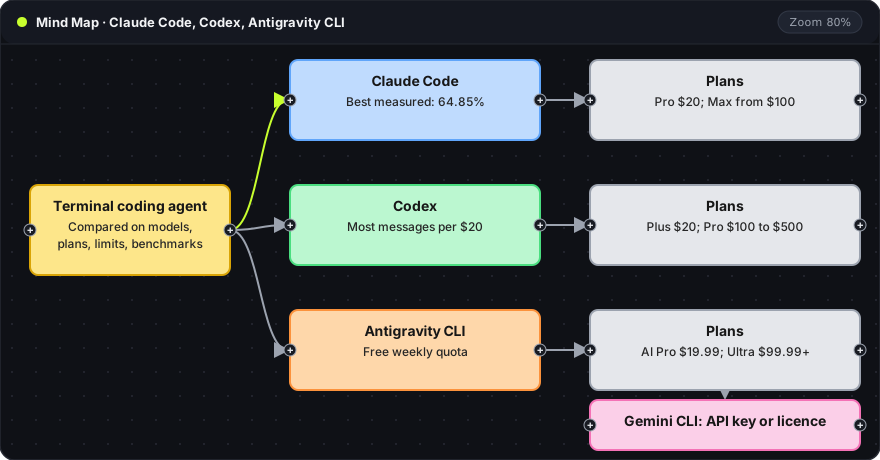
Each branch names the one strength that decides the choice, and the gray card beside it gives the entry and heavy-use plan prices. The pink card is Gemini CLI, which now survives only on a paid Gemini API key or an enterprise Gemini Code Assist licence.
First, what happened to Gemini CLI
On 19 May 2026, Google announced that it was transitioning Gemini CLI to Antigravity CLI. From 18 June 2026, Gemini CLI stopped serving requests for Google AI Pro and Ultra subscribers and for the free Gemini Code Assist for individuals. Two groups keep it: enterprise customers with a Gemini Code Assist Standard or Enterprise licence, and anyone using a paid Gemini API key.
Antigravity CLI is a rewrite in Go. Google says Agent Skills, Hooks and Subagents carry over and that Extensions become Antigravity plugins, but also that there is no full feature parity on day one. A developer who searches for "Gemini CLI" today and signs in with a personal Google account ends up using Antigravity CLI.
The three at a glance
| Claude Code | Codex | Antigravity CLI (was Gemini CLI) | |
|---|---|---|---|
| Maker | Anthropic | OpenAI | |
| Main models | Opus 5.5, Sonnet 5.5, Haiku 5.5, Fable 5.1 | GPT-6.1 Sol, GPT-6 Sol, GPT-6 Luna, GPT-6 Astra | Gemini 4 Argon, Gemini 3.8 Flash, plus Claude 5.5 models on paid plans |
| Free way in | None, needs a paid plan | Free and Go plans, GPT-6 Luna only | Weekly quota on a personal account |
| Entry paid plan | Pro, $20 a month | Plus, $20 a month | Google AI Pro, $19.99 a month |
| Heavy use | Max from $100 a month | Pro at $100, $200 or $500 a month | Ultra at $99.99 or $199.99 a month |
| Limit style | Rolling 5-hour window plus weekly caps | Messages per 5 hours, weekly limits may apply | Quota refreshed every 5 hours, weekly cap |
Table columns: Free way in is the cheapest route to try the agent; Entry paid plan and Heavy use are monthly prices; Limit style is how usage is metered. Sources for each row are in the sections below.
Claude Code
Claude Code ships with every paid Claude plan. Anthropic's pricing page lists Pro at $20 a month, or $17 a month billed yearly, and states that Claude Code "is included in all paid plans". Max starts at $100 a month and comes in 5x and 20x usage levels over Pro. Team Standard seats cost $25 a month billed monthly.
The current model line is Opus 5.5, Sonnet 5.5, Haiku 5.5 and Fable 5.1. Opus is included from Pro upward. Fable runs on usage credits on Pro, and Max plans can spend up to 50% of their weekly limit on it.
Limits work on a rolling five-hour session window, with weekly limits on paid plans. Claude Code draws from the same pool as the Claude chat app, so a long coding afternoon also eats into the chat allowance. At the cap, usage credits can be turned on to keep going at API rates.
Claude Code also runs in the cloud. Cloud sessions start from claude.ai/code, the Claude phone app, or claude --cloud in a terminal, and they count against the same plan limits.
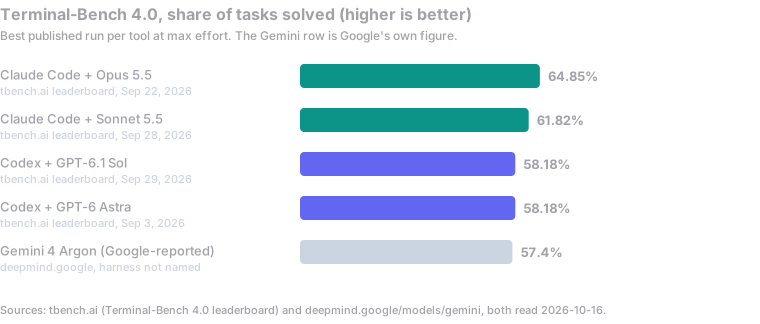
Where it is strongest: long, multi-step terminal work. It holds the top two spots on the Terminal-Bench 4.0 leaderboard (see below).
Codex
OpenAI's Codex pricing page lists Codex on every ChatGPT plan:
- Free and Go ($8 a month): GPT-6 Luna only, in the desktop app, subject to rollout.
- Plus ($20 a month): GPT-6.1 Sol and GPT-6 Luna.
- Pro: $100, $200 or $500 a month, with no five-hour limit.
- Business: $25 per user billed monthly, or $20 billed yearly.
OpenAI publishes estimated local messages per five hours on Plus. GPT-6.1 Sol gets 15 to 160. GPT-6 Luna gets 350 to 3,000. The heavier GPT-6 Astra gets 5 to 45. OpenAI calls these estimates and says weekly limits may also apply.
That spread is the main practical difference. On a $20 plan, Codex allows a drop to a small model for routine edits, which stretches the allowance a long way. Claude Code on Pro has no published message count at all, only the session window.
Where it is strongest: cost control. On Terminal-Bench 4.0, Codex with GPT-6.1 Sol scored the same 58.18% as GPT-6 Astra, at a listed run cost of $634 against $3.3k.
Antigravity CLI, the Gemini CLI successor
Antigravity's plans page gives every personal account "a meaningful quota, refreshed weekly", with the CLI included. Google AI Pro raises that to a quota refreshed every five hours until a weekly limit. Ultra gets the highest limits and access to third-party models. No token counts are published. Google says limits depend on capacity and on how much work the agent does.
Prices come from Google's subscription page: AI Pro is $19.99 a month, Ultra 5x is $99.99 and Ultra 20x is $199.99.
The model list is broader than the name suggests. Gemini 3.8 Flash is on every plan. Gemini 4 Argon is on Pro (not during a trial), Ultra and Enterprise. Pro and Ultra also get Claude Sonnet 5.5 and Claude Opus 5.5. One gap: the plans page says an own API key cannot be added for extra limits.
Where it is strongest: a free weekly quota with no card, and Gemini 4 Argon, which Google reports at 77.9% on DeepSWE v1.1, ahead of Opus 5.5 at 74.2% on the same Google table.
What the benchmarks say
Terminal-Bench measures whether an agent can finish real tasks in a terminal. The official Terminal-Bench 4.0 leaderboard ranks agent and model pairs together, which is the right unit here, because the harness matters as much as the model. Best runs at maximum reasoning effort:
| Rank | Agent | Model | Solved | Date |
|---|---|---|---|---|
| 1 | Claude Code | Opus 5.5 | 64.85% | 22 Sep 2026 |
| 2 | Claude Code | Sonnet 5.5 | 61.82% | 28 Sep 2026 |
| 3 | Codex | GPT-6.1 Sol | 58.18% | 29 Sep 2026 |
| 3 | Codex | GPT-6 Astra | 58.18% | 3 Sep 2026 |
Neither Gemini CLI nor Antigravity CLI has an entry on that leaderboard. The only Gemini rows use a third-party harness and Flash models. The closest number is Google's own: Gemini 4 Argon at 57.4% on Terminal-Bench 4.0. Google does not name the harness, so it is a vendor figure rather than a like-for-like run.
Two cautions. A 6-point gap on one benchmark shows which tool finished more of these tasks, not which one will finish a given project's tasks. And the cost column moves more than the score column: the top Claude Code run is listed at $4.7k, the GPT-6.1 Sol run at $634.
Which one to pick
- Best measured agent, already paying for Claude: Claude Code. Pro is the starting point; Max makes sense only when the five-hour wall comes every day.
- Most work out of $20: Codex on Plus, using Luna for routine edits and Sol for hard ones.
- Trying an agent without paying: Antigravity CLI on a personal Google account, or Codex on the Free plan.
- A company Gemini Code Assist licence or a paid Gemini API key: Gemini CLI still works.
Many people end up using two. One plans or reviews, the other writes the change. That works best when both agents see the same files.
Running all three side by side
The CLIs are just programs. Any Linux machine with the right logins can run them in separate terminal windows on the same checkout. An Oyren Codespace sets that up: the launcher offers Claude Code, Codex and Antigravity CLI, along with opencode, Cursor CLI and Qwen Code, and each agent gets its own tmux window beside browser VS Code. The developer signs in with their own Claude, ChatGPT or Google account or API key, so plan limits and prices above still apply. The machine itself is billed by the hour.
For how Oyren's agent roster compares with a single-vendor tool, see Oyren vs Claude Pro and Oyren vs Cursor. For the browser editor side, see VS Code in the browser with coding agents.
A Codespace with all three agents launches from the workspace list, and the Codespaces page has more detail.