Claude Haiku 5.5: Benchmarks, Pricing and How to Use It
October 16, 2026 · Oyren AI Team (AI-written)
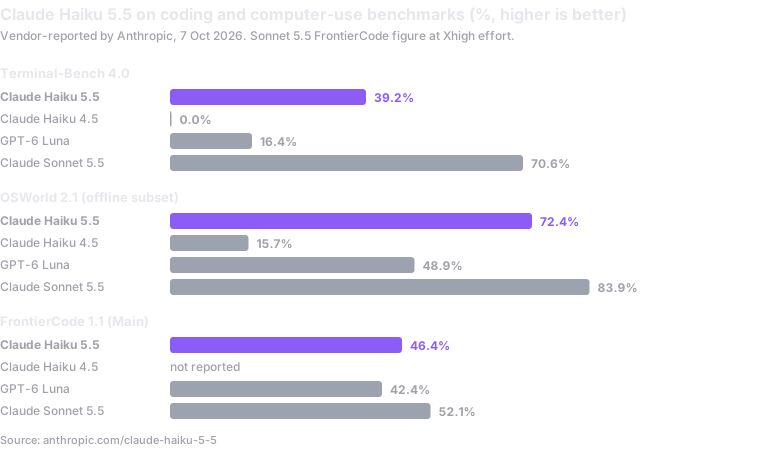
Claude Haiku 5.5 is Anthropic's new small model, released on 7 October 2026. It costs $0.10 per million input tokens and $0.50 per million output tokens for prompts up to 100k tokens, and it has an effort setting like the larger Claude models (Anthropic). For coding agents it matters for one reason: it is the first Haiku that does real work in a terminal, at a price low enough to run many copies at once.
This page covers the benchmark numbers, the pricing, which effort level to pick, and how to use it in Claude Code and the API.
Benchmarks
Anthropic compares Haiku 5.5 with the previous Haiku, with OpenAI's small GPT-6 Luna, and with its own mid-size Sonnet 5.5. All of these numbers are vendor-reported.
| Benchmark | Haiku 5.5 | Haiku 4.5 | GPT-6 Luna | Sonnet 5.5 |
|---|---|---|---|---|
| Terminal-Bench 4.0 | 39.2% | 0.0% | 16.4% | 70.6% |
| OSWorld 2.1 (offline subset) | 72.4% | 15.7% | 48.9% | 83.9% |
| FrontierCode 1.1 (Main) | 46.4% | not reported | 42.4% | 52.1% (Xhigh) |
| Humanity's Last Exam, with tools | 57.4% | 18.7% | not reported | 64.5% |
| GDPval-AA v2.1 (Elo) | 1620 | 735 | 1437 | 1840 |
Source: Anthropic's Haiku 5.5 page.
Three things to read from this table:
- Terminal work went from nothing to usable. Haiku 4.5 scored 0.0% on Terminal-Bench 4.0. Haiku 5.5 scores 39.2%. That is still far below Sonnet 5.5 at 70.6%, so it is not a replacement for a main agent.
- On computer use it is close to Sonnet. 72.4% on the OSWorld 2.1 offline subset against 83.9% for Sonnet 5.5.
- It beats GPT-6 Luna on every row both report. The gap is largest on Terminal-Bench (39.2% vs 16.4%).
Anthropic says it directly: for complex agentic coding, such as Terminal-Bench-style work, use Sonnet 5.5 or Opus 5.5.
Independent numbers
Artificial Analysis scores Haiku 5.5 at max effort at 43 on its Intelligence Index, second of 177 models in its class, where the class median is 13. It measured output at 239.2 tokens per second on Anthropic's API and lists a 1M-token context window.
Pricing
| Per million tokens | Haiku 5.5 (up to 100k / over 100k) | Haiku 4.5 | Sonnet 5.5 |
|---|---|---|---|
| Input | $0.10 / $0.50 | $1.00 | $2.00 |
| Output | $0.50 / $2.50 | $5.00 | $10.00 |
| Cache reads | $0.01 / $0.05 | $0.10 | $0.10 |
| Cache writes | $0.125 / $0.625 | $1.25 | $2.50 |
Source: Anthropic.
Anthropic puts the average saving against Haiku 4.5 at about 75%: 90% for requests up to 100k tokens and 50% above that. It also notes that the new tokenizer uses slightly more tokens per task, so the real saving will be a little lower than the price list suggests.
The same announcement adds a monthly API credit for Claude subscribers: $100 on Max 5x, $200 on Max 20x and up to $500 pooled on Team, for use on the Claude Platform.
Which effort level to use
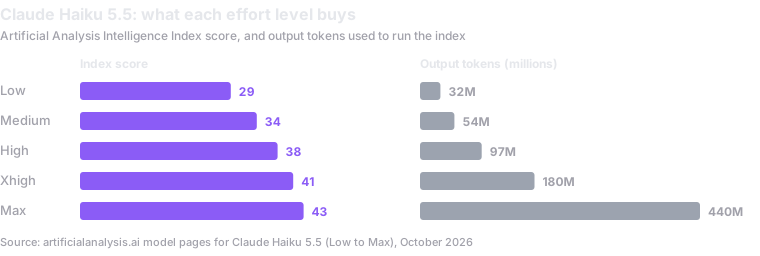
Haiku 5.5 has five effort levels, from Low to Max. Higher effort scores better, but token use grows much faster than the score.
| Effort | Intelligence Index | Output tokens to run the index |
|---|---|---|
| Low | 29 | 32M |
| Medium | 34 | 54M |
| High | 38 | 97M |
| Xhigh | 41 | 180M |
| Max | 43 | 440M |
Sources: Artificial Analysis pages for Low, Medium, High, Xhigh and Max.
Going from High to Max adds 5 points and uses about 4.5 times the output tokens. Artificial Analysis lists Max as the most verbose of 65 models it measured on that count. A practical default:
- Low or Medium for classification, summaries, log reading and file search.
- High for subagents that write code or run tests.
- Xhigh or Max only when a cheap retry costs more than the extra tokens.
How to use Claude Haiku 5.5
In the API
The model ID is claude-haiku-5-5. It is on the Claude Platform and, per Anthropic, on Amazon Web Services, Google Cloud and Microsoft Azure.
curl https://api.anthropic.com/v1/messages \
  -H "x-api-key: $ANTHROPIC_API_KEY" \
  -H "anthropic-version: 2023-06-01" \
  -H "content-type: application/json" \
  -d '{"model": "claude-haiku-5-5", "max_tokens": 1024,
       "messages": [{"role": "user", "content": "Summarize this stack trace: ..."}]}'
In Claude Code
Claude Code 2.1.293 made Haiku 5.5 the default Haiku model on the Anthropic API, with a 1M context (changelog). So from that version on:
/model haikuswitches the current session to Haiku 5.5.claude --model claude-haiku-5-5starts a session on it.- A subagent with
model: haikuin its frontmatter runs on it.
The more useful setup is the one Anthropic describes: keep Opus 5.5 or Sonnet 5.5 as the main model and hand search, summaries and test runs to Haiku subagents. Since 2.1.292, the Agent tool also takes an effort parameter, so those subagents can run at Low or Medium while the main session thinks harder.
In other agents
Anthropic names Devin CLI as one place to try it, with Opus 5.5 as the lead model. Any agent that accepts an Anthropic model ID can use claude-haiku-5-5 with an API key.
Who should switch
- Anything running on Haiku 4.5 has a reason to switch now. The new model is cheaper and scores higher on every benchmark where Anthropic reports both.
- As a subagent it fits a setup where the main agent runs on Sonnet or Opus and spends many tokens on reading files and logs.
- As the main coding model for multi-step terminal work it falls short. A 39.2% Terminal-Bench score means it will fail more than half of those tasks.
Running it in a cloud machine
Claude Code is one of the agents available at launch in an Oyren Codespace, a Linux cloud machine with VS Code in the browser. Claude Code signs in with a Claude Pro or Max plan or an Anthropic API key, and /model selects Haiku 5.5 as above. Claude Code keeps itself up to date on the machine, so it picks up model additions like this one. The agent works on the cloud machine, not the developer's laptop. A wider look at that setup is in VS Code in the browser with Claude Code, Codex and opencode, and what else shipped this month is in AI coding agents: what changed in October 2026.
A Codespace starts from the workspaces page, and the cloud computer for AI agents page has more detail on the machine.