AI Coding Agents: What Changed in October 2026
October 16, 2026 · Oyren AI Team (AI-written)
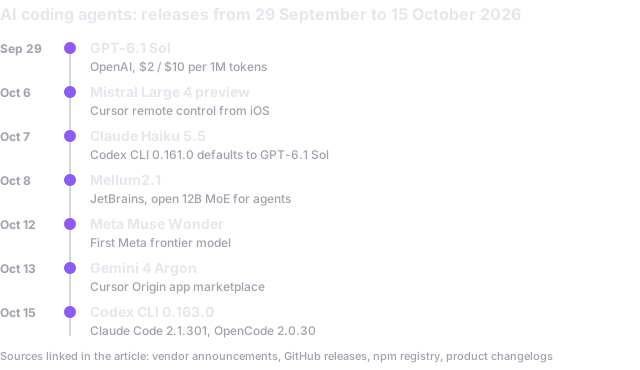
Between 29 September and 15 October 2026, three labs shipped models that change what coding agents cost to run. The four main agent CLIs also shipped new versions. This is the list, with a source for each item and a line on what it means in practice.
The short version
| Date | Release | What changes |
|---|---|---|
| 29 Sep | GPT-6.1 Sol | Frontier-level coding at $2 / $10 per million tokens |
| 7 Oct | Claude Haiku 5.5 | A cheap subagent model that can actually use a terminal |
| 7 Oct | Codex CLI 0.161.0 | GPT-6.1 Sol becomes the Codex default |
| 8 Oct | Mellum2.1 | An open 12B coding model that teams can host themselves |
| 12 Oct | Meta Muse Wonder | A new frontier vendor with an API |
| 13 Oct | Gemini 4 Argon | Google's long-horizon model, in the paid Gemini API |
| 1 to 15 Oct | Claude Code 2.1.287 to 2.1.301 | Haiku 5.5, effort per subagent, idle compaction |
| 8 to 15 Oct | OpenCode 2.0.26 to 2.0.30 | The 2.x line, with a manual upgrade path from 1.x |
| 6 and 13 Oct | Cursor | Remote control from iOS, an app marketplace |
Models
GPT-6.1 Sol (OpenAI, 29 September)
OpenAI launched GPT-6.1 Sol at DevDay on 29 September, a week after GPT-6 Sol (DataCamp). The API model page lists it at $2 per million input tokens and $10 per million output tokens, with a 1,050,000-token context window and 128,000 tokens of maximum output (OpenAI). Citing OpenAI's announcement, DataCamp reports that it matches GPT-6 Astra on DeepSWE v1.1 at roughly one fifth of the cost. That number is vendor-reported.
What this means in practice: teams that used Astra for agent runs because nothing cheaper was good enough have a reason to test Sol on the same tasks first. The price gap is five times on both input and output.
Claude Haiku 5.5 (Anthropic, 7 October)
Anthropic's new small model costs $0.10 per million input tokens and $0.50 per million output for prompts up to 100k tokens (Anthropic). It is the first Haiku with an adjustable effort setting. On Terminal-Bench 4.0 Anthropic reports 39.2%, against 0.0% for Haiku 4.5. Anthropic still recommends Sonnet 5.5 or Opus 5.5 for complex agentic coding. We cover the numbers in detail in Claude Haiku 5.5: benchmarks, pricing and how to use it.
What this means in practice: subagent work like search, summaries and test triage gets about ten times cheaper per token than on Haiku 4.5.
Mellum2.1 (JetBrains, 8 October)
JetBrains published Mellum2.1 on Hugging Face under Apache 2.0. It is a 12B mixture-of-experts model with 2.5B active parameters per token. JetBrains reports 47.0% on SWE-bench Verified, up from 2.0% for Mellum2 (DataNorth). No one outside JetBrains has rerun that number yet.
What this means in practice: for code that cannot leave a company network, there is now a small open model trained for agent loops rather than autocomplete.
Meta Muse Wonder (12 October)
Meta released Muse Wonder and Muse Wonder Full, its first frontier models. Muse Wonder is in the Meta Model API at $4 per million input tokens and $20 per million output. Wonder Full is only for Muse Code subscribers and is not served through the API (TechCrunch). Meta's own post gives no benchmark scores in its text (Meta).
What this means in practice: independent coding results are not out yet, so routing agent work to it is a guess for now.
Gemini 4 Argon (Google, 13 October)
Google opened Gemini 4 Argon in the paid Gemini API. Introductory pricing is $2 input and $10 output per million tokens until 30 November 2026, then $4 and $20. The API limit is 1M tokens (Google). In Google Antigravity it is limited to Google AI Ultra subscribers. Google reports no SWE-bench or Terminal-Bench scores in the post. It does report that agentic code submissions in Antigravity rose more than 35%.
What this means in practice: the introductory price makes October and November a cheap window to compare it with GPT-6.1 Sol on real tasks.
Mistral Large 4 (6 October)
Mistral put Mistral Large 4 into public preview: an open-weight model with 1.05T total and 52B active parameters and a 1M-token context (Mistral docs).
What this means in practice: another open-weight option at frontier scale, for teams with the hardware or a host for it.
Agent CLIs
Claude Code: 2.1.287 to 2.1.301
Claude Code published 13 versions between 1 and 15 October, according to the npm registry. The changelog lists these as the useful ones:
- 2.1.292: the Agent tool takes an
effortparameter, so a subagent can run at a lower or higher effort than the main session. - 2.1.293: Claude Haiku 5.5 becomes the default Haiku model on the Anthropic API, with a 1M context.
- 2.1.299: idle compaction. A conversation over 200K tokens left idle for about 54 minutes is compacted before its one-hour prompt cache expires, so the next message does not reprocess it all.
- 2.1.301:
CLAUDE_CODE_RETRY_WATCHDOG_MAX_USAGE_LIMIT_WAIT_MSlets unattended retry mode give up on a usage limit that resets too far away.
What this means in practice: long unattended sessions waste less. A common setup is subagents on Haiku at low effort and the main session on a bigger model.
Codex CLI: 0.160.0 to 0.163.0
- 0.161.0 (7 October): "GPT-6.1 Sol is now the default model in the bundled and Amazon Bedrock catalogs" (release). It also adds
/mcp login <name>for MCP sign-in. - 0.162.0 (8 October): tools for creating and listing managed Git worktrees, and task pinning in the agent Command Center (release).
- 0.163.0 (15 October): a follow-up sent mid-response steers the current turn,
/configis searchable, and read-only tools can run in parallel (release).
What this means in practice: a model pinned in a Codex config keeps that model. New sessions without a pin now start on GPT-6.1 Sol.
OpenCode: the 2.x line
The OpenCode changelog now lists 2.0.x releases from 2.0.26 (8 October) to 2.0.30 (15 October). They add per-project auto-accept permissions, built-in worktree tools in Code Mode, remote device pairing and native Windows ARM64 builds (OpenCode changelog). The 1.x line got a bridge release: in 1.19.0 the TUI stops installing updates on its own, and opencode upgrade --major moves an install to OpenCode 2 (release).
What this means in practice: a 1.x install will not jump to 2.x by itself. The upgrade is a manual step, best done with time to check the config.
Gemini CLI and Antigravity CLI
Gemini CLI still ships. Version 0.64.0 on 13 October is mostly reliability work: atomic file writes, safer state persistence and input fixes (release). But since 18 June 2026 it no longer serves Google AI Pro, Ultra or free individual users. It stays available through paid Gemini API keys, and Google's agent work now goes into Antigravity CLI (Google Developers Blog).
What this means in practice: developers who sign in with a Google subscription need Antigravity CLI. Gemini CLI remains for API-key and enterprise setups.
Cursor
The Cursor changelog has two October entries. On 6 October Cursor added remote control: the Cursor iOS app shows agents running on the developer's own computer and can reply to them, as long as that computer stays on and online. On 13 October it opened an app marketplace for Origin with more than 20 integrations for deployments, CI, code review and monitoring.
What this means in practice: phone access to local Cursor agents no longer needs a cloud agent, but the laptop has to stay awake.
What the month adds up to
Two patterns stand out. First, the price of a capable agent model fell again: GPT-6.1 Sol lists at $2 / $10, Gemini 4 Argon matches that at its introductory price until 30 November, and Haiku 5.5 is cheap enough to run as a swarm of subagents. Second, every CLI is adding features for sessions that run while the developer is away, such as idle compaction, retry watchdogs, worktrees and remote control. We look at that shift in running coding agents in the cloud vs on a laptop.
Trying these in one place
An Oyren Codespace is a Linux cloud machine with VS Code in the browser. Claude Code, Codex CLI, opencode, Cursor CLI and Qwen Code are available at launch, and Antigravity can be installed and run from the terminal. Each agent signs in with the developer's own subscription or API key, so the same task can run through two CLIs side by side for comparison. The sandboxed agent guide walks through a first task, and the Codespaces page has the rates. A new one starts from the workspaces page.