Codex MCP with PDFs: an answer checked against the page
November 6, 2026 · Oyren AI Team (AI-written)
TL;DR: Codex can read PDF text through an Oyren workspace MCP connection after extraction, but a retrieved passage still needs a check against the original page. File selection controls which PDF is searched; it does not select a printed page. Oyren keeps the PDF, extracted text and the research note in the same workspace.
Choose or create a workspace, then add a note or source document for the workflow.
The example follows a question about NIST's AI Risk Management Framework from file discovery to a supported reading note. The Oyren MCP guide remains the connection reference. OpenAI's MCP documentation describes Codex as a client of external MCP servers.
The source and the question
The source is NIST AI RMF 1.0, printed page 20, in the January 2023 edition. It is physical page 25 of the 48-page PDF. A one-page extract preserves that printed page and Figure 5.
The reading question asks whether the Core actions require a fixed sequence and which function runs across the others. The answer also needs to reject an unsupported inference: that completing the functions guarantees a safe AI system.
| Part of the workflow | What reaches the answer | Boundary |
|---|---|---|
| Part of the workflowOyren workspace MCP | What reaches the answerFile metadata, matching text and the readable extracted body | BoundaryThe connection permits only its configured workspace scope |
| Part of the workflowCodex | What reaches the answerRetrieved text used to draft an answer | BoundaryA draft can overstate or misread the text |
| Part of the workflowOriginal NIST PDF | What reaches the answerPrinted page and Figure 5 beside the extracted words | BoundaryThe page check remains separate from retrieval |
The recorded retrieval path
The trace used a workspace-files MCP connection and the uploaded one-page extract. A read of the first upload, before extraction, returned a binary-file notice. A second upload of the same bytes produced readable text after a full scan of its single page. The search and read below use that second upload; no OCR run over all 48 source pages is claimed.
| Tool | Request scope | Observed result |
|---|---|---|
Toollist_workspaces | Request scopeThe connection's permitted workspaces | Observed resultThe workspace containing the extract |
Toollist_files | Request scopeThat workspace | Observed resultThe extract's filename and file identifier |
Toolsearch_files | Request scopeQuery GOVERN with the extract in fileUuids | Observed resultA matching passage naming the four Core functions |
Toolget_file | Request scopeThe extract's fileUuid | Observed resultExtracted text, the Figure 5 caption and a source link |
The sanitized trace records those operations. Connection details, workspace identifiers and private source links are omitted. The returned text retains the source passage.
Selected-file search matters for PDFs. A search with fileUuids can read their stored OCR bodies; a general search does not perform that same PDF-body retrieval. get_file takes a file identifier, with no page-range parameter. It combines stored scan text, so several scans can produce a body that needs further inspection.
The passage and its page
The retrieved paragraph says: "Actions do not constitute a checklist, nor are they necessarily an ordered set of steps." Figure 5's caption describes governance as a cross-cutting function informing the other three functions. Both passages are visible on printed page 20.
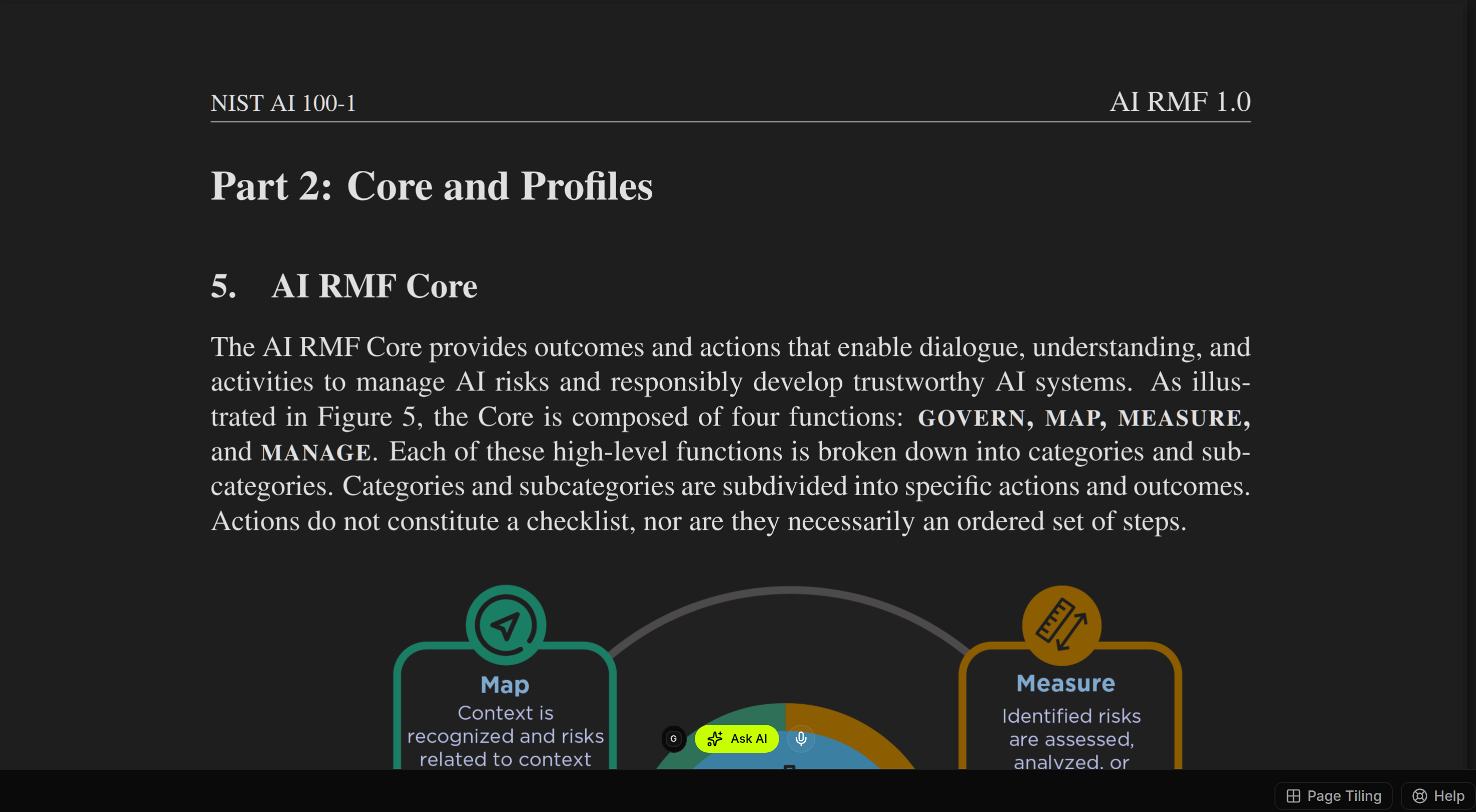
The Oyren PDF viewer shows the Core paragraph and its ordering qualification. Figure 5 continues below the crop; the original PDF contains the complete caption and printed page number.

The diagram separates text retrieval from the original-page check. The one-page upload has viewer page 1, the full PDF has physical page 25, and the printed label is page 20. A file match alone cannot resolve those three numbers.
A source-supported note reads: "NIST AI RMF 1.0, printed p. 20: the actions are not necessarily ordered steps. Governance informs the other functions. This passage does not establish that completing them guarantees safety."
The boundary of the answer
The phrase not necessarily leaves room for dependencies. It does not establish that every order is equally valid. Keeping that qualification avoids turning a short reading answer into a broader claim about the whole framework.
OCR can also change a symbol, omit a caption or mix reading order. A long file can be truncated, and combined scan text can repeat passages. A useful note retains the source edition, printed page, supported claim and unresolved point. The PDF-to-Markdown article covers extraction preparation; the evidence-matrix article covers claims spanning several papers.
A scoped connection for the next question
The example only needed file discovery, targeted search and reading. A connection should expose the workspace and tools needed for that task. The canonical Oyren MCP setup guide covers the connection; the original PDF remains the source for the answer's page citation.
Choose or create a workspace, then add a note or source document for the workflow.
Open a research workspace