How to cite arXiv preprints and their versions
October 16, 2026 · Oyren AI Team (AI-written)
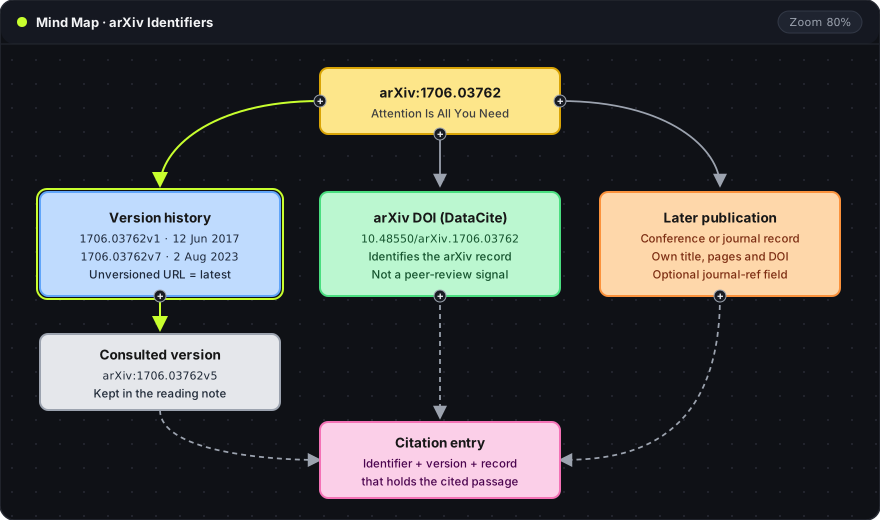
Recommendation: An arXiv citation needs the identifier, the version that was read, and accurate metadata copied from the abstract page. When a published version exists, the record that actually contains the cited passage decides whether the reference points to the journal article or to a specific arXiv version.
Three identifiers for one paper
A single arXiv paper can carry several identifiers. Each one answers a different question. The abstract page for arXiv:1706.03762, the 2017 Transformer paper by Vaswani et al., shows all of them:
- arXiv identifier (
1706.03762): the paper in the archive. The first four digits are the year and month of the first submission (June 2017), followed by a sequence number. - Version suffix (
v1tov7): each revision the authors uploaded. Version 1 was submitted on 12 June 2017 and version 7 on 2 August 2023. The submission history on the abstract page lists every version with its date. - arXiv DOI (
10.48550/arXiv.1706.03762): a DataCite DOI that arXiv assigns to every paper. It resolves to the arXiv record. It does not indicate peer review. - Later publication: a conference or journal version with its own title, pages and publisher DOI. Authors can link it from the arXiv record through the optional journal reference and DOI fields described in arXiv's journal reference guide.
The abstract page for 1706.03762 has no journal reference, even though the paper appeared at NeurIPS 2017. The field is optional and filled in by the authors, so an empty field does not mean the paper was never published.
Version pinning
arXiv's versions guide explains that an unversioned link such as arxiv.org/abs/1706.03762 always shows the latest version. If the authors later change a table or remove a result, an unversioned citation points readers to text that no longer matches the claim.
A versioned identifier fixes the reference to one revision:
arXiv:1706.03762v5
https://arxiv.org/abs/1706.03762v5
arXiv:marks the string as an arXiv identifier in the text of a reference.1706.03762is the paper.v5is the revision that was read. The reading note should record it at the time of reading, because the latest version may change later.
A version suffix matters most when the citing sentence depends on a specific number, equation, table or appendix. For a general reference to the paper's main idea, the unversioned identifier is usually enough, subject to the target style guide.
A BibTeX entry with arXiv fields
The abstract page has an "Export BibTeX Citation" link. The exported entry is a starting point, and its fields should be compared with the page. A complete entry for this paper looks like this:
@misc{vaswani2017attention,
  title         = {Attention Is All You Need},
  author        = {Vaswani, Ashish and Shazeer, Noam and Parmar, Niki
                   and Uszkoreit, Jakob and Jones, Llion and Gomez, Aidan N.
                   and Kaiser, Lukasz and Polosukhin, Illia},
  year          = {2017},
  eprint        = {1706.03762},
  archivePrefix = {arXiv},
  primaryClass  = {cs.CL},
  doi           = {10.48550/arXiv.1706.03762}
}
@misc: the entry type most styles use for preprints.vaswani2017attention: the citation key. It is a local label used in\cite{}, not part of the paper's identity.author: the full author list in order, separated byand. Shortening it to "and others" belongs to the output style, not the data.eprint: the arXiv identifier. Writing1706.03762v5here records a specific version.archivePrefixandprimaryClass: tell arXiv-aware BibTeX styles to printarXiv:1706.03762 [cs.CL].cs.CLis the primary category shown on the abstract page.doi: the arXiv DOI. It identifies the preprint record, not the NeurIPS paper.
biblatex users can write the same data as eprinttype = {arxiv} and eprintclass = {cs.CL}.
Preprint or published version
When a paper has both a preprint and a published version, the cited passage decides which record to use:
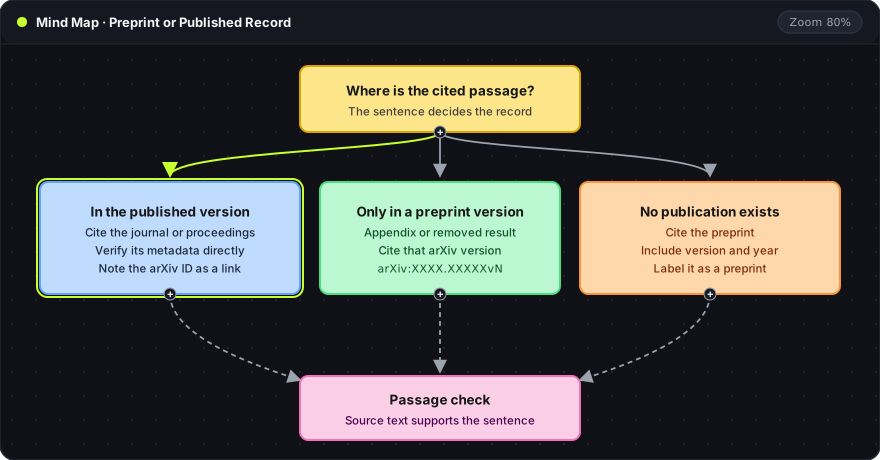
| Where the cited passage is | Record to cite | Metadata source |
|---|---|---|
| In the published version | The journal or proceedings article | Publisher page and publisher DOI |
| Only in a preprint version, such as a removed appendix | That arXiv version, with its suffix | arXiv abstract page |
| No published version exists | The arXiv preprint, labelled as a preprint | arXiv abstract page |
Many journals and style guides ask for the published version when one exists. That rule works only when the published text still contains the passage. Peer review can change results, remove sections or rename methods, so the passage needs checking in the final record before the reference is switched.
Adding the arXiv identifier to a published-version reference is common and harmless. It gives readers a free copy without changing what is cited.
A verification table for each reference
Each check below answers a separate question. A reference can pass one and fail another:
| Check | Question answered |
|---|---|
| Identifier resolution | Does the identifier or DOI open a record? |
| Metadata comparison | Do title, authors and year match that record? |
| Version comparison | Is it the version that was actually read? |
| Passage review | Does the source text support the citing sentence? |
| Style review | Does the entry meet the target journal's format? |
Identifier resolution and metadata comparison catch wrong papers. Version comparison and passage review catch the harder problem: the right paper cited for a claim that a different version, or no version, supports. The DOI handbook describes how DOIs resolve, but a resolving DOI only proves that the record exists.
Imports into a reference manager
Reference managers often create two records for one paper: one imported from arXiv and one from the publisher. Before merging them, the note should record which version holds the cited passage. Merging on a matching title alone can drop the arXiv version suffix or replace the preprint metadata with the journal's, which breaks the link between a sentence and the text that supports it.
Common import errors to compare against the abstract page:
- Author lists truncated or reordered.
- Title capitalisation lost, because many BibTeX styles lowercase words that are not wrapped in braces.
- The
eprintfield missing, so the printed reference shows no arXiv identifier. - The publication year taken from the latest version instead of the first submission.
Frequently asked questions
Does an arXiv DOI mean the paper was peer reviewed?
No. arXiv assigns a 10.48550 DOI to every paper it accepts. It identifies the arXiv record. Peer review status comes from the publication venue, not from the DOI.
Which year belongs in an arXiv citation?
Styles differ. The BibTeX entry above uses 2017, the year of the first submission and the year encoded in the identifier. When a specific later version is cited for one passage, some styles use that version's date instead. The target style guide decides.
Should the citation use the preprint or the published version?
The published version, when it contains the cited passage and the target venue prefers published sources. A specific arXiv version, when the passage exists only there. The table in the section on preprint and published versions lists all three cases.
Source records in Oyren
Oyren's research notes keep the source record, the version read and the passage notes in one place, next to the draft argument. The research paper translation guide covers another workflow where the original document stays part of the check.