How to Translate a Research Paper PDF and Keep the Formulas
October 16, 2026 · Oyren AI Team (AI-written)
Recommendation: A layout-preserving translator finds the text blocks on each page, protects the formulas, translates the prose and draws it back into the original boxes, and each of those four steps has a documented way to fail. A side-by-side check of equation numbers, terminology, layout flags and references catches those failures before a translated paper is quoted or cited.
How layout-preserving PDF translation works
Pasting a paper into a chat window keeps the words but loses the page: figures, equation numbers, tables and the column layout a reader uses to find things. Layout-preserving tools keep the page. The open-source ones follow the same four-step pipeline:
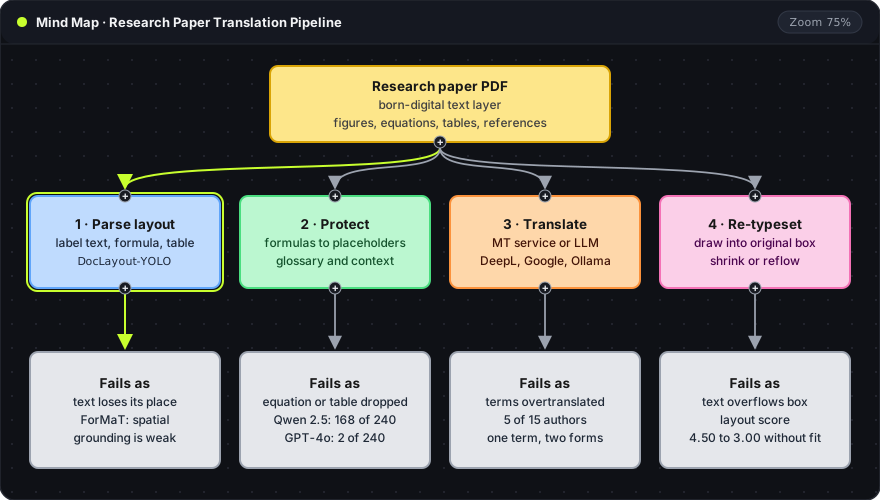
The colored branches are the four steps in order, left to right. The gray card under each step is how that step fails, with the measurement behind it. Those failures are covered in the next sections.
- Parse the layout. A detection model labels each region as text, title, formula, table, figure or caption. PDFMathTranslate (Ouyang, Chu, Xin and Ma, EMNLP 2025 System Demonstrations) uses DocLayout-YOLO for this step.
- Protect what must not change. Formulas are swapped for placeholders before the text goes to the translator. BabelDOC (Qi Yang, Xiangyao Ma, Xiao Wang, Hao Wang and Rui Wang, ACL 2026 System Demonstrations) adds terminology extraction, cross-page context and glossary-constrained generation to this step.
- Translate. Text goes to a machine translation service or a large language model. PDFMathTranslate supports at least 23 of them, including DeepL, Google and local models through Ollama.
- Re-typeset. The translation is drawn into the original boxes. Translated text is often longer than the source, so the tool shrinks the type or reflows the text without covering a figure.
The PDFMathTranslate authors state the limits directly: translation quality "remains highly dependent on the underlying translation models and prompts", layout accuracy depends on the detection model, and scanned PDFs without good OCR are out of reach.
Measuring translation quality
No single score says whether a translated paper is usable. Researchers combine five kinds of measurement:
- Overlap metrics. BLEU (Papineni, Roukos, Ward and Zhu, ACL 2002) counts word sequences in the output that match a human reference. It is cheap and still widely reported, but it rewards matching words, not meaning.
- Learned metrics. COMET (Rei, Stewart, Farinha and Lavie, EMNLP 2020) scores a translation with a multilingual neural model trained on human quality judgements, reading the source and the reference together.
- Expert error annotation. In MQM (Multidimensional Quality Metrics), professional translators mark each error by type and severity. Freitag, Foster, Grangier et al. (TACL 2021) found that professional MQM ratings ranked systems quite differently from crowd workers. The WMT25 general translation task (Kocmi, Artemova, Avramidis et al., 2025) used professional annotators on harder, multi-paragraph test sets, under the title "Time to Stop Evaluating on Easy Test Sets".
- Comprehension tests. Science Across Languages (Calzi Kleidermacher and Zou, Findings of EACL 2026) checks whether a reader of the translation can still answer questions about the paper. An LLM writes quiz questions from the English article and answers them from the translation. GPT-4o translations of six articles into 28 languages scored 95.9% on average, from 91.7% for Tamil to 98.0% for Swedish.
- Layout metrics. BabelDOC measures how well translated element boxes line up with the original (BIoU) and counts untranslated text blocks per page. Humans and an LLM judge also rated four qualities on a 200-page benchmark of papers, technical documents and patents:
| Human rating (1 to 5) | DeepL (document) | PDFMathTranslate | BabelDOC |
|---|---|---|---|
| Layout fidelity | 3.44 | 3.29 | 4.59 |
| Translation precision | 3.62 | 3.40 | 4.28 |
| Terminology consistency | 4.21 | 3.34 | 4.47 |
| Untranslated blocks per page (lower is better) | 2.33 | 6.25 | 2.85 |
The first three rows are human ratings, where higher is better. The last row is a count. BabelDOC and PDFMathTranslate share an author, and the benchmark is the authors' own, so the table describes one team's evaluation rather than an independent comparison.
Known failure modes
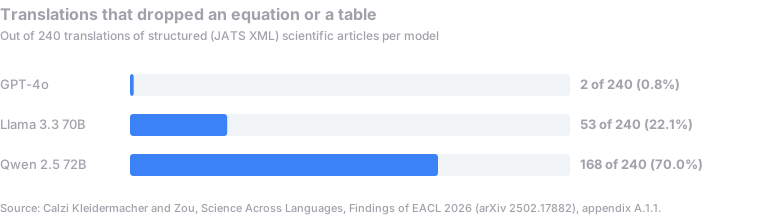
Formulas and tables go missing. Language models sometimes drop content instead of mistranslating it. In the Science Across Languages appendix, each model translated 24 structured articles into 10 languages, 240 translations per model:
Each bar is one model. Its length is the number of translations, out of 240, that left out at least one equation or table: 2 for GPT-4o, 53 for Llama 3.3 70B and 168 for Qwen 2.5 72B. These were 2024 models, so current rates differ. The pattern holds: a missing equation does not look like an error on the page. It is simply absent.
Terminology is overtranslated or inconsistent. In the same study's survey, 13 of 15 authors who read their own paper in their native language described an unnatural quality or were unhappy with the technical vocabulary. Five of the 15 raised overtranslation: terms translated that their field keeps in English. Two saw one term translated two different ways in the same article, likely because sections were sent separately. In BabelDOC's ablation, removing glossary and context control dropped its terminology consistency score from 5.00 to 3.00.
Text does not fit. Without adaptive typesetting, BabelDOC's layout fidelity fell from 4.50 to 3.00 in the same ablation. Longer translated text overlaps figures or is cut off.
Text loses its place on the page. The ForMaT dataset (Ciesiółka, Wiśniewski, Charkiewicz and Guttmann, EAMT 2026), 3,956 PDFs in 15 language pairs, found that current systems struggle with spatial grounding: the link between a piece of text and its place in the layout.
References are unmeasured. None of the papers above measures what happens to the bibliography. Author names, journal titles and DOIs have to stay exactly as printed, because they are what a reader searches for later.
One passage, five checks
The failure modes become concrete on a single sentence. This passage is constructed for illustration, in the style of a machine learning paper:
The objective in Eq. (3),
L(θ) = Σᵢ ℓ(f_θ(xᵢ), yᵢ), is minimized with Adam (Kingma and Ba, 2015) at a learning rate of 3e-4, as in Table 2.
| Element in the source | Check in the translation | Failure it catches |
|---|---|---|
Eq. (3) | The number (3) is unchanged and points to the same equation | Dropped or renumbered equation |
L(θ) = Σᵢ ℓ(f_θ(xᵢ), yᵢ) | Every symbol and subscript is identical to the source | Formula sent to the translator instead of protected |
Adam | Kept as the optimizer's name, not translated as a word | Overtranslated term |
(Kingma and Ba, 2015) | Names and year exactly as printed | Altered reference |
3e-4, Table 2 | Number and table label unchanged | Changed number or lost table link |
The table has one row per element a translator can damage. The middle column is what a reviewer compares on the two pages. The right column ties each check back to a documented failure. Every row is a direct comparison, so no knowledge of the target language is needed for this part of the review.
A review workflow that catches the errors
A full paper gets the same checks, grouped into four branches around the translated document:
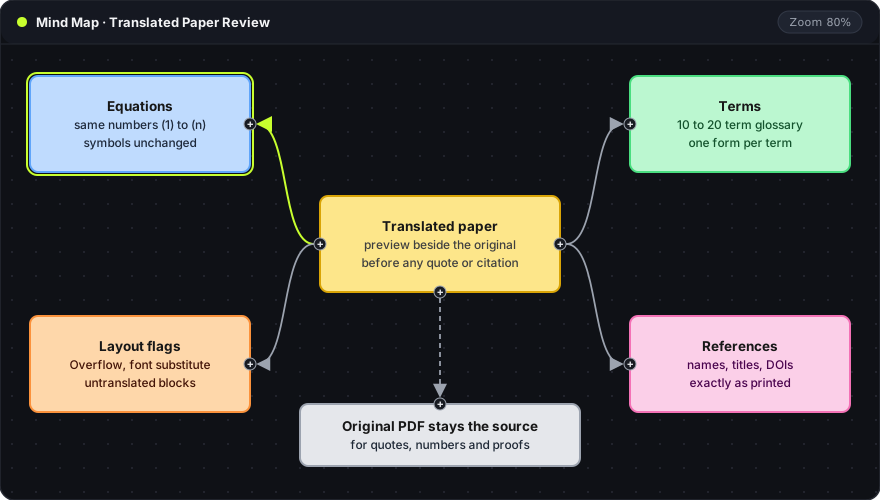
- Purpose first. Reading to understand a paper tolerates small errors. Quoting it, citing a number or building on a proof does not, and for those the original is the source.
- A real text layer. Scanned papers need OCR before any translation. Born-digital papers usually do not.
- A short glossary. Ten to twenty terms the field keeps in English, or translates a specific way, go into a tool that accepts one.
- Equations counted. If the original has equations (1) to (14), the translation has them too, with identical symbols. The same count applies to tables and figures.
- Flagged sections first. Overflowing boxes, substituted fonts and untranslated blocks are where layout tools report trouble, so those pages are read first.
- Citations point to the original. Quotes and citations use the paper as published, not a translation of it.
The gray card at the bottom of the map is step 6. It stays separate from the four branches because it applies even when every check passes.
Translating a paper in Oyren
The Oyren PDF Translator works inside the PDF viewer of a workspace and translates into 27 languages. It is built around the failure modes above:
- Formulas. Blocks it reads as equations, formulas, code or figures are never sent for translation.
- Locked values. Inside the text, numbers, URLs, email addresses and inline code are locked. A section that comes back with one of them changed is rejected.
- Fit. Each translation is drawn in the original box. Long text shrinks evenly down to 60%, and anything that still does not fit is flagged as Overflow.
- Fonts. Where the PDF's fonts lack the characters, Noto fonts stand in, and the review list says so.
- Output. The translation opens as a preview. Sections can be applied or retried, and the result is saved as a new PDF next to the original.
A scanned paper needs its text made editable first. Oyren offers that step before translating, and both steps use AI credits. For maths-heavy scans, the comparison of OCR for scientific PDFs with equations covers that first step. In a workspace, Translate sits in the PDF toolbar.
Frequently asked questions
Does a layout-preserving translator translate formulas?
No. Formulas are detected and replaced with placeholders before translation, then restored unchanged. The failure is detection: a formula the layout model misses is sent as text and can be altered or dropped.
Which metric says a translated paper is usable?
None on its own. Overlap and learned metrics score the wording, comprehension tests score whether the content survived, and layout metrics score the page. The equation count and the five passage checks above cover what those scores miss.
Are the BabelDOC ratings independent?
No. BabelDOC and PDFMathTranslate share an author, and the 200-page benchmark is the authors' own. The ratings are useful as one evaluation, not as a neutral ranking.
Is a translated paper safe to cite?
A translated paper is a reading aid. Citations, quotes and reported numbers come from the original as published.