The AI proof of the quasi-Riemann hypothesis: what is proved
November 6, 2026 · Oyren AI Team (AI-written)
TL;DR: On 6 October 2026 OpenAI released 721 mathematics manuscripts in 373 families, including two preprints on the quasi-Riemann hypothesis: a 199-page paper for Re(s) > 7/8 whose main theorem is formalized in Lean 4, and a 49-page human-edited paper for Re(s) > 11/12 that is not formalized in Lean and is being checked by number theorists. For researchers reading either preprint, an Oyren research workspace keeps the PDF, margin notes, five-model chat and Lean 4 in a Codespace in one place.
Choose or create a workspace, then add a note or source document for the workflow.

The diagram separates the two preprints in OpenAI's repository from the verification work around them. The 30 September manuscript has a Lean 4 proof of its main zero-free region and omits its later applications, whereas the stronger 5 October manuscript rests on human mathematical review.
What OpenAI released on 6 October 2026
On 6 October 2026 OpenAI published Sharing AI progress in mathematics (updated on 15 October with a 5 million dollar Simons Foundation initiative for Lean formalization tools) and opened the openai/math repository under the Apache-2.0 license. The repository README lists 721 manuscripts organized into 373 families, produced by an unnamed, unreleased internal OpenAI model that spent roughly three hours of ChatGPT Pro thinking compute per result across about 4,000 problems.
OpenAI states that roughly 42 percent of the top-line results in the collection have Lean 4 formalizations. The repository changelog records why formalization and human reading both matter: on 7 October, one day after release, three manuscripts were withdrawn after a sign error was found in a stabilization-trace cancellation argument, 14 manuscripts were revised, leaving 300 formalized results out of 719 at that point, and two more manuscripts were added on 26 October.
Two preprints on the quasi-Riemann hypothesis
The Riemann hypothesis places every nontrivial zero of the Riemann zeta function on the vertical line $\text{Re}(s) = 1/2$. A quasi-Riemann hypothesis establishes a zero-free half-plane $\text{Re}(s) > 1 - \delta$ for a fixed constant $\delta > 0$, bounding how close a zero can get to the line $\text{Re}(s) = 1$. OpenAI's collection contains two separate preprints in this family, dated five days apart, and they differ in both strength and verification status.
| 30 September 2026 preprint | 5 October 2026 preprint | |
|---|---|---|
File in openai/math | 30 September 2026 preprint199-page paper.pdf | 5 October 2026 preprint49-page paper2.pdf |
| Claimed zero-free half-plane | 30 September 2026 preprint$\text{Re}(s) > 7/8$ | 5 October 2026 preprint$\text{Re}(s) > 11/12$ |
| Functions covered | 30 September 2026 preprintFinite-order Hecke $L$-functions over $\mathbb{Q}(\sqrt{-3})$, Dirichlet $L$-functions and $\zeta(s)$ | 5 October 2026 preprintDirichlet $L$-functions, including $\zeta(s)$ |
| Landau-Siegel zeros | 30 September 2026 preprintCovered for the $\text{Re}(s) > 7/8$ bound | 5 October 2026 preprintExplicitly rules out Landau-Siegel zeros in the abstract |
| How the text was prepared | 30 September 2026 preprintRaw model manuscript | 5 October 2026 preprintEdited with human assistance for readability |
| Lean 4 status | 30 September 2026 preprintMain result formalized (lean/docs/003.md); later applications are not included | 5 October 2026 preprintNot formalized in Lean |
| Current review | 30 September 2026 preprintMain theorem machine-checked in Lean 4 | 5 October 2026 preprintRead and rewritten into 7-to-13-page notes by number theorists |
In the 30 September 199-page paper, the Lean 4 documentation page lean/docs/003.md maps the main theorem to OAI.riemannZeta_ne_zero_of_seven_eighths_lt_re inside OAI/NumberTheory/DirichletL/Nonvanishing.lean, and notes that the paper's later applications are not included in the formalization. In the 5 October 49-page paper, the title page notes that the manuscript was written with human assistance to make the argument easier to read, and no Lean file accompanies it.
Why mathematicians still have to read the 49-page paper
In Quanta Magazine's 19 October 2026 report (AI Proved the Quasi-Riemann Hypothesis. What Happens Now?), Konstantin Kakaes describes how analytic number theorists responded to the two files. Researchers largely set aside the 199-page manuscript and read the 49-page version instead. Maksym Radziwiłł of Northwestern University told Quanta that both papers are "horribly written (in a way that would lead to immediate rejection at any mathematical journal)", and noted that the core idea can be sketched on half a page once the unnecessary detours are stripped away. Across the field, 7-to-13-page human write-ups of the argument began circulating privately within days.
Number theorists quoted by Quanta largely agreed that the proof holds, while treating human comprehension as the real threshold. Princeton mathematician Peter Sarnak repurposed a graduate course this semester to work through the preprint line by line, saying that he will not call the result "a Theorem" until humans have checked and understood all the details.
Terence Tao makes a related point on his Views on AI and mathematics page: the preprints "appear to introduce clever new ideas that will be fruitful once digested", while "none of the humans involved in these proofs are available to take questions, give talks, attend conferences, submit papers to journals, train students". When a paper has no human co-author to explain which lemma carries the weight and which ten pages are routine bookkeeping, the reader has to reconstruct that map directly on the PDF.
Reading an AI math preprint in an Oyren research workspace
Working through a dense preprint like the 49-page October 5 manuscript follows four steps in an Oyren research workspace, which starts from the workspaces page:
- Upload the PDF to the workspace library and mark the main theorem, definitions and suspect transitions directly on the page with Highlight, Pen or LaTeX annotations.
- Select a dense sentence in the PDF and click Ask AI for a quick single-model check, or click Continue in chat to compare up to five models on the same passage.
- Connect Claude Code, Codex or ChatGPT to the workspace over MCP so an external assistant reads the extracted paper text and reading notes in place.
- Open a Codespace with Lean 4 and Mathlib when a definition or small lemma is worth testing in the Lean InfoView.
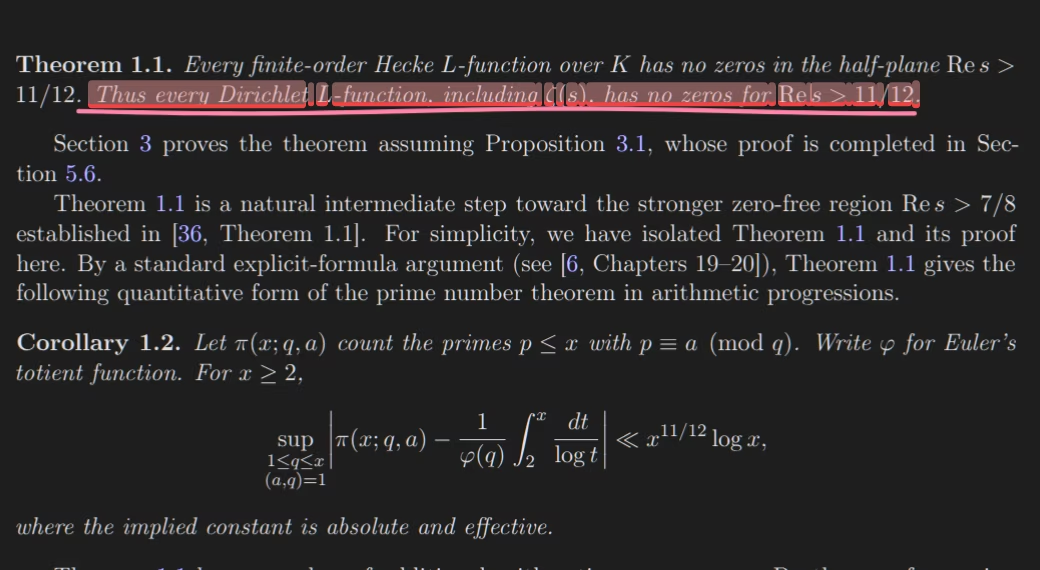
The capture above shows page 2 of OpenAI's 49-page preprint (paper2.pdf, Apache-2.0) open in the Oyren PDF reader. Theorem 1.1, which states that every Dirichlet $L$-function including $\zeta(s)$ has no zeros for $\text{Re}(s) > 11/12$, is marked with the Highlight and Pen tools from the top toolbar, alongside LaTeX, Note, Shape, Image and Eraser tools for keeping a running trail of checked and unchecked lemmas on the page itself.
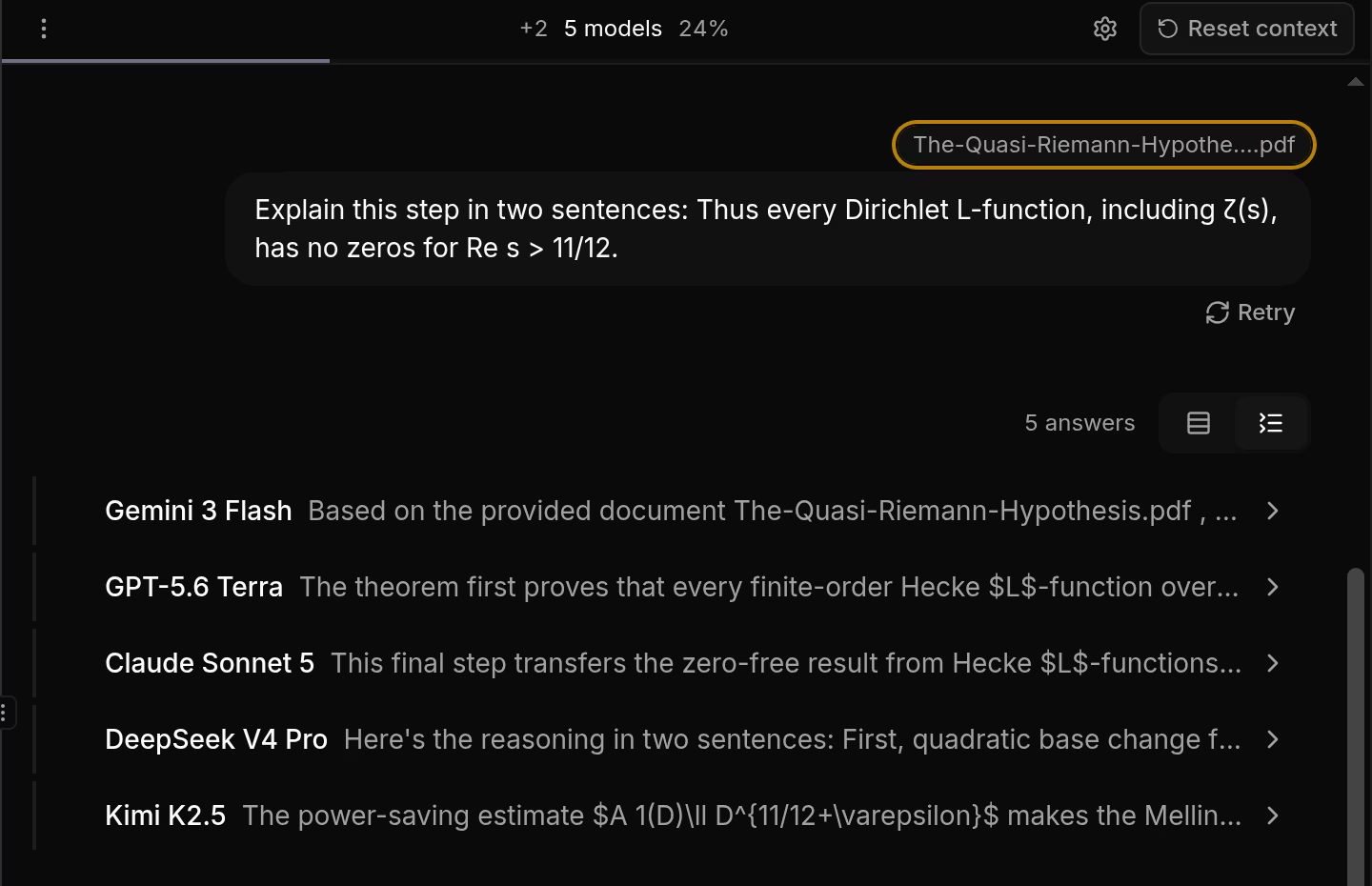
When a passage on the page is selected, the inline Ask AI popover answers with one model right over the PDF. Clicking Continue in chat hands the quoted passage into workspace chat, where up to five models answer side by side on the same prompt. In the capture above, Gemini 3 Flash, GPT-5.6 Terra, Claude Sonnet 5, DeepSeek V4 Pro and Kimi K2.5 each explain Theorem 1.1 in two sentences next to the attached PDF. Comparing several models on one paragraph makes it easier to spot when one model invents a bridge step that is not in the text, a failure mode covered in the AI literature review limits post.
For researchers who want to inspect Lean 4 code alongside their notes, an Oyren Codespace runs VS Code in the browser with Lean 4 and Mathlib pre-installed, at $0.174 an hour (1,740 credits) for a Small 4 vCPU, 8 GB RAM machine at the Free plan rate on 6 November 2026 (model usage is billed separately). The AI theorem proving in Lean 4 and Lean 4 and Mathlib in cloud VS Code posts cover how interactive proof checking works in that environment.
What Oyren does not do
An Oyren workspace is a reading, note-taking and Lean 4 environment, not an automated referee for unformalized papers:
- Opening
paper2.pdfin Oyren does not verify or formalize the 49-page $\text{Re}(s) > 11/12$ proof. That verification is the work number theorists and graduate seminars are doing by hand and in Lean. - Inline Ask AI inside the PDF reader queries one model at a time; side-by-side comparison across up to five models happens after clicking Continue in chat.
- A Lean 4 Codespace checks only the Lean files and statements loaded into the project, such as OpenAI's published
lean/folder or a reader's own scratch lemmas.
Questions about the quasi-Riemann hypothesis preprints
Did OpenAI prove the full Riemann hypothesis?
No. The full Riemann hypothesis places every nontrivial zero on $\text{Re}(s) = 1/2$. OpenAI's two preprints establish zero-free half-planes $\text{Re}(s) > 7/8$ and $\text{Re}(s) > 11/12$, which bound zeros away from $\text{Re}(s) = 1$ and rule out Landau-Siegel zeros.
Which of the two preprints is formalized in Lean 4?
The 30 September 2026 199-page preprint has its main theorem (OAI.riemannZeta_ne_zero_of_seven_eighths_lt_re) formalized in Lean 4, with its later applications omitted (lean/docs/003.md). The 5 October 2026 49-page preprint for $\text{Re}(s) > 11/12$ is not formalized in Lean.
How many manuscripts are in the OpenAI math repository?
The openai/math README lists 721 manuscripts organized into 373 families under the Apache-2.0 license, with roughly 42 percent of top-line results formalized in Lean 4.
Why are mathematicians rewriting the 49-page preprint?
Because a machine-generated manuscript is hard to referee and teaches little until its core mechanism is isolated. As Quanta Magazine reported on 19 October 2026, specialists have condensed the 49-page argument into 7-to-13-page human notes and seminar lectures so the community can verify every step.
Next step for reading the preprints
Reading and annotating paper2.pdf alongside five-model chat, Markdown notes and a Lean 4 Codespace starts with a research workspace on the workspaces page. The research page and Lean 4 notes guide describe how the PDF reader, notes and Lean 4 fit together.
Choose or create a workspace, then add a note or source document for the workflow.
Open a research workspace