The same research question in several AI models
November 6, 2026 · Oyren AI Team (AI-written)
TL;DR: The same research question can expose differences between AI answers when the source passage and instructions stay fixed. A useful comparison ends with a claim checked against the original page. Oyren keeps the model replies alongside the PDF and the resulting research note.
Choose or create a workspace, then start a chat using an available model.
Two short answers agreed about a paragraph in NIST's AI Risk Management Framework, using different levels of detail. The example below follows that wording from the source through each answer to a checked note.
One passage, two independent answers
The source is NIST AI RMF 1.0, printed page 20, which is physical page 25 in the January 2023 PDF. It describes the Core functions GOVERN, MAP, MEASURE and MANAGE. This is a reading exercise using that edition.
Both requests received the same three-sentence passage and question: does the excerpt require a fixed sequence, which function is cross-cutting, and does completing the functions guarantee a safe AI system? The instructions limited the answer to 50 words and the supplied excerpt. The complete input is preserved.
| Part of the comparison | What it contributes | Limit |
|---|---|---|
| Part of the comparisonOyren workspace | What it contributesTwo labeled replies, a source PDF and a place for the checked note | LimitKeeping material together does not verify a claim |
| Part of the comparisonSame passage and question | What it contributesA common reading task | LimitOne excerpt cannot establish claims about the whole framework |
| Part of the comparisonDifferent requested models | What it contributesTwo independently generated summaries | LimitOne answer per model cannot establish a quality ranking |
The requests used temperature 0.3 and concise answer mode. They ran sequentially, each without the other model's answer in its input. Browsing and tools were disabled. The recorded IDs were available catalog selections; the study did not independently audit the provider behind each response.
The saved answers
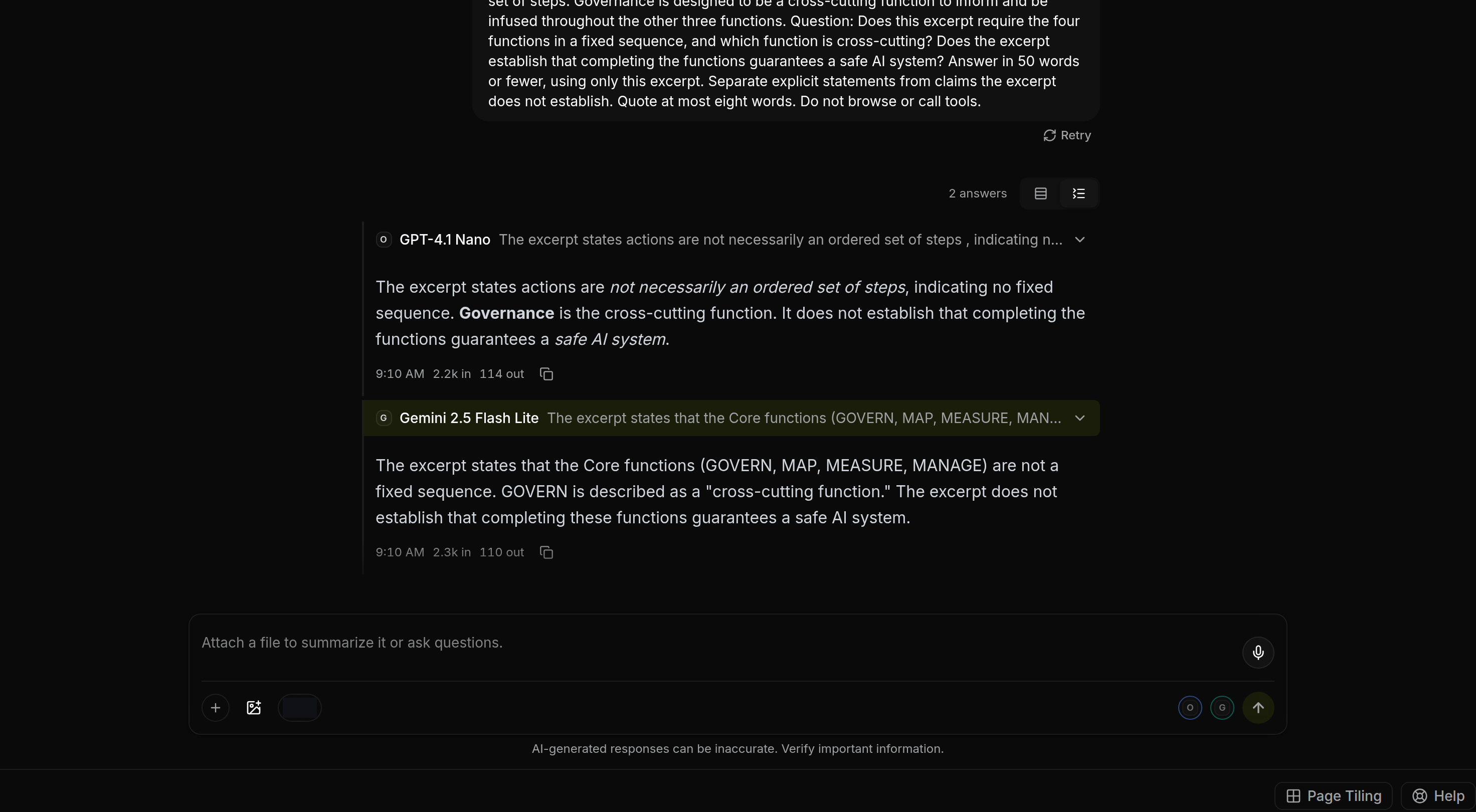
The saved Oyren conversation shows both replies to the same excerpt. Each answer is expanded; the separate downloads below retain its original Markdown.
GPT-4.1 Nano, requested as openai/gpt-4.1-nano:
The excerpt states actions are not necessarily an ordered set of steps, indicating no fixed sequence. Governance is the cross-cutting function. It does not establish that completing the functions guarantees a safe AI system.
Gemini 2.5 Flash Lite, requested as google/gemini-2.5-flash-lite:
The excerpt states that the Core functions (GOVERN, MAP, MEASURE, MANAGE) are not a fixed sequence. GOVERN is described as a "cross-cutting function." The excerpt does not establish that completing these functions guarantees a safe AI system.
These are the complete main answers, with their original Markdown. The first answer, second answer and request record are available separately. Automatic follow-up suggestions are recorded outside the main answers.
The qualification in the source
The page says the actions are not necessarily an ordered set of steps. GPT retains that qualification in its opening quotation, then summarizes it as no fixed sequence. Gemini paraphrases the conclusion at the level of the four functions. Both support the answer that the excerpt does not require a fixed sequence; neither establishes that every ordering is valid.
Both identify cross-cutting governance and reject the proposed safety guarantee as unsupported by the excerpt. Their agreement is useful for locating those claims. The PDF supplies the evidence.
| Claim in the reading note | Source check |
|---|---|
| Claim in the reading noteActions are not a checklist and are not necessarily ordered steps | Source checkSupported on printed page 20 |
| Claim in the reading noteGovernance informs the other three functions | Source checkSupported on printed page 20 |
| Claim in the reading noteAny order is equally valid | Source checkNot established by the passage |
| Claim in the reading noteCompleting the functions guarantees safety | Source checkNot established by the passage |
From replies to a research note

The branches keep the two answers separate until the page check. The saved note retains the source's qualification and its printed page number. The evidence-matrix article extends this approach to claims from several papers.
A concise note from this example reads: "NIST AI RMF 1.0, printed p. 20: actions are not necessarily ordered steps; governance informs the other functions. The passage does not establish a guarantee of safety."
Scope and cost of this example
Each chat turn reported 3 credits, or $0.0003, including its automatic follow-up suggestions. The two chat turns cost 6 credits ($0.0006). Supporting PDF extraction cost another 150 credits ($0.015), including one empty extraction attempt. The combined cost was 156 credits ($0.0156), at 10,000 credits per dollar. These are recorded charges for this example, not a quote for other tasks.
One response per model cannot measure consistency, accuracy across subjects or the effect of a different prompt. A disagreement would require the same source check. The Oyren chat page describes the multi-model workspace used for this kind of comparison.
Choose or create a workspace, then start a chat using an available model.
Open a chat workspace