lemo-opuscar: what it is and what it needs
November 11, 2026 · Oyren AI Team (AI-written)
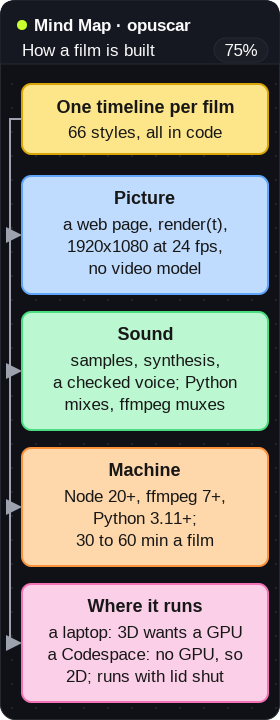
TL;DR: lemo-opuscar by Lemomo (LemoLab) is a Claude Code plugin with 66 film styles made in code, its code MIT licensed and its demo films CC BY 4.0. Each style is a style prompt plus a demo film drawn by web pages, rendered frame by frame, mixed in code and encoded with ffmpeg, with no video model involved. A film takes 30 to 60 minutes of agent work and needs Node 20+, ffmpeg 7+ and Python 3.11+, a long job that suits a cloud machine such as an Oyren Codespace, where Claude Code keeps working after the laptop closes.
Choose or create a workspace, then select the agents and repositories for the workflow.
lemo-opuscar is the first library in this series on new AI repositories. The post is not affiliated with Lemomo or LemoLab, and every fact about the library below comes from the repository at commit bebbbe1 of 31 October 2026.
What lemo-opuscar is
The README calls it a toolbox of film styles made in code, "66 ready to use". Its author is Lemomo, who made the films with Claude Opus 5.5; one style, Memphis Diorama, was contributed by @EianLu. A style is a prompt in styles/<style>/STYLE.md plus one demo film made entirely in code; the agent keeps the style's look, colour, type, motion and sound, and writes its own story for the topic it is given. AGENTS.md sorts the 66 styles into 11 groups, from Hand-drawn & Painting and Print & Printmaking to Games, Cinema & Eras and Materials & 3D, and the gallery shows the demo films.
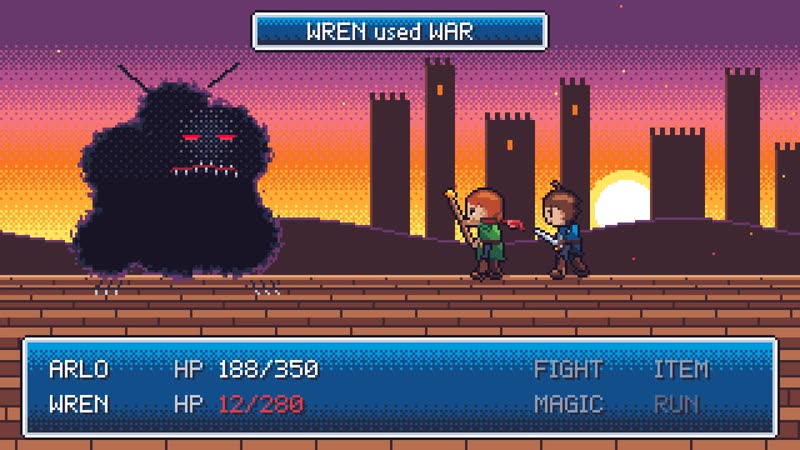
Still from the 16-bit Pixel RPG demo film by LemoLab, from lemo-opuscar, CC BY 4.0, shown unchanged.
The README carries a warning in its first lines: the styles are tuned for Claude Opus 5.5, and other models may not reproduce them well. The repository had 14,868 stars and 1,801 forks on 11 November 2026, about six and a half weeks after it was created on 26 September.
How a film is built
Every film is code. TECHNIQUE.md puts one timeline at the centre and drives five parts from it: the picture is a web page with a render(t) function that headless Chrome captures frame by frame, the voice is text to speech checked by speech recognition, the music is scored from sample libraries and synthesis, and foley and subtitles follow the same clock. A mix step written in Python ducks, compresses and balances the sound, and ffmpeg then muxes it with the picture, with two-pass loudness normalisation to -14 LUFS. In the README's words: "No video generation, no stock footage."
The agent works like a small studio. It asks one round of questions, writes a treatment with three candidate structures and picks one, then builds the film from three guides: DIRECTOR.md for story, sound and rhythm, TECHNIQUE.md for the pipeline, and the style's own STYLE.md. A film takes about 30 to 60 minutes "and a fair amount of tokens", and the default output is 1920x1080 at 24 frames a second (plugin edition README).
What it needs on a machine
The system tools are Node 20+, ffmpeg 7+ and Python 3.11+ or uv; the 6.x line of ffmpeg under-reports audio length during loudness normalisation, and the mux step then rejects the file (TECHNIQUE.md). The library was developed on macOS, the authors expect Linux to work, and 3D and shader-heavy styles want a GPU. Without one, WebGL runs in software: 2D-canvas styles are unaffected, while 3D and CRT styles are slow (the browser renderer).
The first film downloads the rest: about 10 MB of npm packages, a headless Chromium of 100 to 200 MB, and about 150 MB of Python packages. Voice models, a speech-check model, sample libraries and 3D lighting files come only when a film needs them (plugin edition README). The same README states that the topic, files and film stay on the machine and that the plugin sends nothing to its authors; the one exception is the Chinese online voices, which send narration text to Microsoft's speech service after the skill asks.
Licences and credit
The code and documentation are MIT licensed, "Copyright (c) 2026 LemoLab" (LICENSE). The demo films and their stills are CC BY 4.0: sharing, adapting and commercial use are allowed with credit to LemoLab, a link to the repository and a note of any change. Fonts in core/fonts are OFL, and the sample libraries and 3D lighting files keep their own licences (plugin edition README). Three voice tracks in the demos are excluded from the licence and must not be reused, and third-party assets in the demos keep their own licences. The README asks no credit for a film made with the library and leaves its maker responsible for the materials used in it; Oyren credits the library anyway.
Tips for a first film
- Pinning a commit keeps runs repeatable: the skill's setup script updates a library folder it manages from the repository's main branch on every run, while a clone checked out by hand stays at its commit.
- English narration uses Kokoro, which runs offline; only the Chinese online voices send text out.
- The video skills post covers another set of video tools for Claude Code in a Codespace, and the tmux guide explains why a long render keeps going after the browser tab closes.
Questions about lemo-opuscar
Is lemo-opuscar free?
The code and documentation are MIT licensed and cost nothing. Each film uses "a fair amount of tokens" from the agent's plan or API key, plus the machine it runs on.
Does lemo-opuscar work with models other than Claude?
The README says the styles are tuned for Claude Opus 5.5 and other models may not reproduce them well. The skill folder can be copied into other agents' skills folders.
Does it need a GPU?
Only for some styles. 2D-canvas styles need no GPU, while 3D styles and 2D styles with a WebGL2 pass, such as CRT, VHS or film damage, run slowly without one.
What does the licence say about a film made with it?
The README's licence section says films made with the library need no credit, and that whoever makes a film is responsible for the materials used in it. The demo films and stills are separate: they need a CC BY 4.0 credit to LemoLab.
Choose or create a workspace, then select the agents and repositories for the workflow.
Open Codespace setup