Memory prices nearly doubled: cloud machines for coding agents
November 6, 2026 · Oyren AI Team (AI-written)
TL;DR: TrendForce reported that conventional DRAM contract prices rose 93 to 98 percent quarter over quarter in Q1 2026 as memory makers shifted capacity to AI servers, a squeeze Sam Altman pointed to on 29 October 2026 when arguing against leaving scarce DRAM idle in personal computers. For builders whose laptops run out of memory when Claude Code, Codex and opencode build several branches at once, an Oyren Codespace rents a cloud Linux machine with 8 to 32 GB of RAM for 1 hour to 30 days.
Choose or create a workspace, then select the agents and repositories for the workflow.

The diagram connects the 2026 memory market to day-to-day agent workflows. When server demand absorbs wafer capacity and consumer RAM tiers stay expensive, builders running parallel coding agents can either buy more local memory up front, maintain a rented Linux server by hand, or book a cloud machine for the time a build actually runs.
What Sam Altman argued on 29 October 2026
In a 29 October 2026 interview with John Collison on the Cheeky Pint podcast (Substack transcript, YouTube recording), OpenAI CEO Sam Altman made a resource-utilization argument about where memory should sit during a global DRAM shortage:
"...it's quite terrible to have everybody have a bunch of the world's limited supply of DRAM sitting in their own computer. And, being used [...] 5% of the time."
The 5 percent figure is Altman's conversational estimate, not a measured dataset. His underlying point is straightforward: a 64 GB or 128 GB laptop bought for peak workloads leaves most of that DRAM idle whenever the machine is asleep in a backpack or handling light editing, whereas memory in a shared cloud pool can serve active jobs across many users throughout the day.
What happened to DRAM prices and supply in 2026
Altman's remark came after ten months of documented shifts from consumer memory toward AI data-center memory:
- 3 December 2025: Micron announced that it was exiting the Crucial consumer memory and storage business, with consumer shipments continuing through fiscal Q2 (February 2026), citing AI-driven growth in the data center as the reason for reallocating supply (Micron investor release).
- 2 February 2026: TrendForce raised its 1Q26 conventional DRAM contract price forecast to 90 to 95 percent quarter over quarter, up from an earlier 55 to 60 percent forecast, projecting PC DRAM contract prices to rise by more than 100 percent in a single quarter and server DRAM by about 90 percent (TrendForce 2 February release).
- 31 March 2026: TrendForce projected 2Q26 conventional DRAM contract prices to rise another 58 to 63 percent quarter over quarter as manufacturers prioritized high-bandwidth memory (HBM) and server DDR5 (TrendForce 31 March release).
- 1 June 2026: TrendForce reported the realised 1Q26 numbers: conventional DRAM contract prices rose 93 to 98 percent quarter over quarter, and total DRAM industry revenue jumped 81 percent quarter over quarter to 97 billion dollars as suppliers prioritized high-capacity RDIMMs for AI servers (TrendForce 1 June release).
- 30 September 2026: TrendForce projected 4Q26 conventional DRAM contract prices to grow 10 to 15 percent quarter over quarter and warned that PC DRAM supply could shrink in 2027 even if consumer demand remains soft, because wafer capacity continues moving to server lines (TrendForce 30 September release).
For a developer pricing a new laptop or desktop upgrade, those contract increases show up as steep step-ups between 16 GB, 32 GB and 64 GB configurations, right as coding agents ask for more memory per project.
Why parallel coding agents exhaust laptop RAM
A single terminal running Claude Code, Codex or opencode uses very little memory for the agent CLI itself. As the measurements in the coding agent memory usage post show, the memory goes to the child processes the agent starts inside its working tree:
- Language servers and indexers:
tsserver,rust-analyzer,pyrightor the Java and Kotlin daemon hold gigabytes of syntax trees in RAM. - Compilers and bundlers:
next build,tsc --noEmit, Gradle and Cargo spike memory on every verification pass. - Test runners and browsers: Jest workers and headless Playwright Chromium instances add hundreds of megabytes to several gigabytes per run.
When a developer gives three or four agents their own branches using git worktrees, each worktree starts its own build and test processes at the same time. On a 16 GB laptop, two concurrent TypeScript builds alongside a browser and an IDE can push the machine into swap; on a 32 GB cloud server, Oyren's own engineering team hit memory pressure when running 26 to 30 concurrent agents and had to add a memory-gated job queue (running 30 AI coding agents on one machine).
A high-RAM laptop, an own Linux server or an Oyren Codespace
Three setups handle parallel coding agents, and they trade upfront hardware cost against metered compute and setup work.
| High-RAM laptop | Own rented Linux server | Oyren Codespace | |
|---|---|---|---|
| Where builds and tests run | High-RAM laptopThe developer's laptop | Own rented Linux serverA rented cloud VM over SSH | Oyren CodespaceA cloud Linux machine in the browser |
| Laptop closed | High-RAM laptopLocal agents and builds stop | Own rented Linux serverAgents keep running in tmux | Oyren CodespaceAgents keep running for the booked time |
| Parallel agents | High-RAM laptopLimited by the laptop's fixed RAM | Own rented Linux serverLimited by the VM's RAM; managed by hand | Oyren Codespace8 GB (Small), 16 GB (Medium and Large) or 32 GB (X-Large) |
| Installed agents | High-RAM laptopAny CLI installed locally | Own rented Linux serverAny CLI installed by the operator | Oyren CodespaceClaude Code, Codex, opencode, Cursor CLI, Qwen Code, Antigravity CLI |
| Phone access | High-RAM laptopRequires a wake lock and remote-control app | Own rented Linux serverAn SSH client | Oyren CodespaceA running Codespace in a phone browser, one app at a time |
| Compute cost | High-RAM laptopPaid up front in the laptop purchase price | Own rented Linux serverMonthly or hourly VM bill while the server exists | Oyren Codespace$0.174 an hour (1,740 credits) for a Small machine at the Free rate on 6 November 2026; model usage separate |
Moving parallel agent builds to an Oyren Codespace
Offloading heavy builds and parallel agent tasks from a laptop to an Oyren Codespace takes four steps, starting from the workspaces page:
- Launch a Codespace on the repository in the size that matches the build (Small at 4 vCPU and 8 GB RAM, Medium at 4 vCPU and 16 GB RAM, Large at 8 vCPU and 16 GB RAM, or X-Large at 8 vCPU and 32 GB RAM) and pick a booking duration from 1 hour to 30 days.
- Create a separate git worktree on the machine for each task branch so parallel agents never overwrite each other's index or build output.
- Open a tmux window or a Chat session per worktree with Claude Code, Codex, opencode, Cursor CLI, Qwen Code or Antigravity CLI signed in with the developer's own plan or API key.
- Track each agent's branch and status in Offices and on the workspace Kanban board, then stop the Codespace early if the work finishes ahead of schedule so unused time after the first hour is refunded.

The duration picker above sets how long the cloud machine stays up without a browser tab connected. Credits are reserved at launch and unused time after the first hour returns to the balance when the machine stops early; partial minutes are rounded up. Bookings of 7 days or more discount the per-minute rate by 10 percent, and 30-day bookings discount it by 25 percent; full rates for every machine size are listed on the plans page. Running a Codespace on a personal computer or own server is in closed beta testing and is not open to all accounts today.
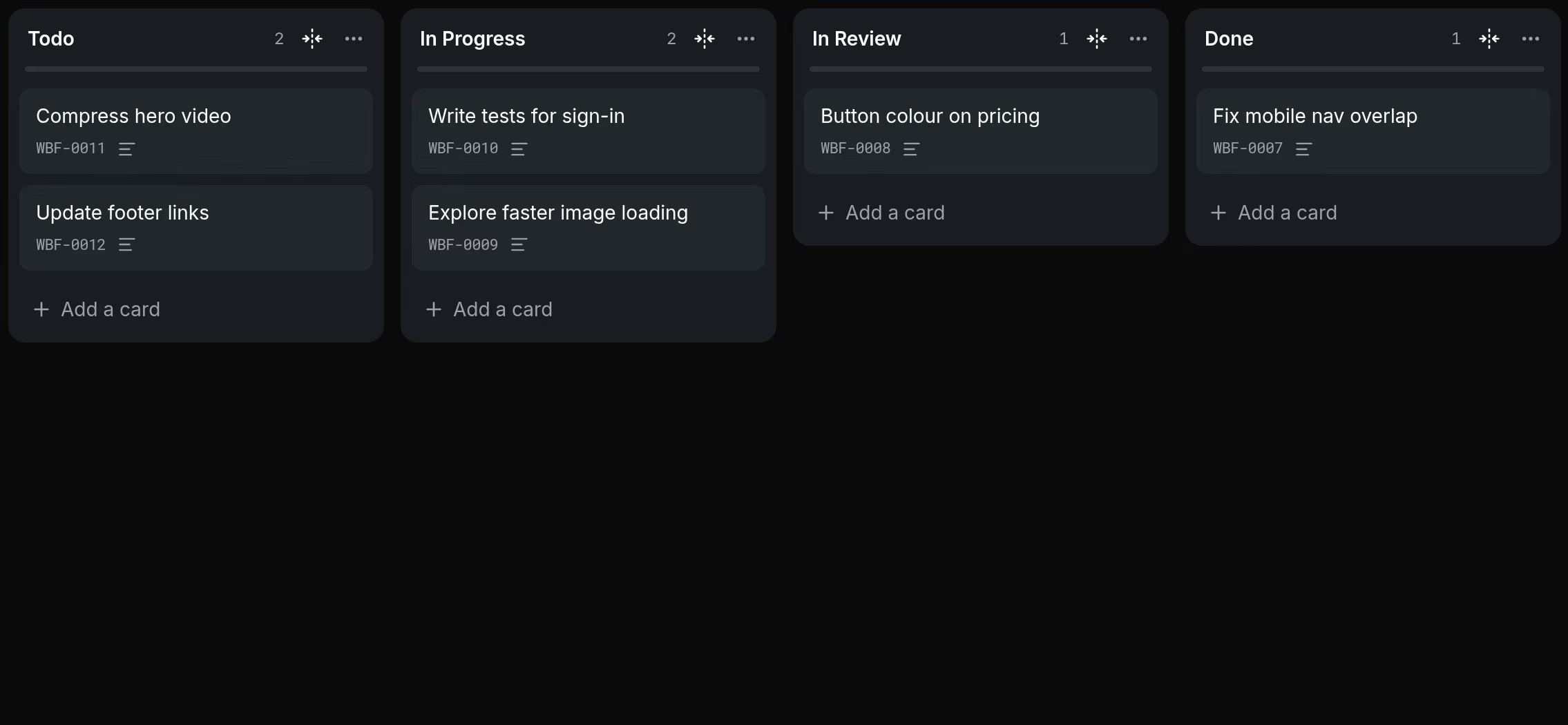
The capture above shows a development workspace Kanban board updated over the workspace MCP server. While several agents compile and run tests in their own worktrees on the cloud machine, cards move across Backlog, Todo, In Progress and Done, and a running Codespace can be checked from a phone browser one app at a time (phone workflow guide).
Where a laptop with local RAM is stronger
Buying local RAM on a laptop is still the better choice for three kinds of work:
- Local device emulators and native GUI apps: Android Studio's emulator, Xcode's iOS Simulator and desktop graphics tools rely on local GPU acceleration and display windows that a headless Linux container does not replace.
- Offline work: A laptop on a flight or a train runs local compilers, tests and local models without a network connection.
- All-day interactive editing with no hourly meter: Once the hardware is paid for, leaving a single IDE and language server open all day adds no per-hour compute charge.
For bursty workloads, such as running four coding agents across separate branches for an afternoon or running a long test suite overnight with the laptop closed, renting cloud memory by the minute avoids sizing the laptop for the heaviest two hours of the week.
Questions about DRAM prices and cloud machines for coding agents
How much did DRAM contract prices rise in early 2026?
TrendForce reported on 1 June 2026 that conventional DRAM contract prices rose 93 to 98 percent quarter over quarter in Q1 2026, with total DRAM industry revenue rising 81 percent quarter over quarter to 97 billion dollars (TrendForce 1 June release).
Why did Micron exit the Crucial consumer memory business?
In its 3 December 2025 announcement, Micron stated that AI-driven growth in the data center led to a surge in demand for memory and storage, and that exiting the Crucial consumer business after fiscal Q2 (February 2026) would improve supply and support for larger strategic customers (Micron release).
How much RAM does an Oyren Codespace have?
Codespaces come in four sizes: Small (4 vCPU, 8 GB RAM), Medium (4 vCPU, 16 GB RAM, 320 GB disk), Large (8 vCPU, 16 GB RAM, 480 GB disk) and X-Large (8 vCPU, 32 GB RAM). At the Free plan rate on 6 November 2026, a Small machine costs $0.174 an hour (1,740 credits), with model usage billed separately.
What happens to agents in a Codespace when the laptop closes?
The cloud Linux machine keeps running for the duration booked at launch, from 1 hour to 30 days, and tmux sessions keep Claude Code, Codex and opencode working while the browser is closed.
Next step for running coding agents on cloud RAM
Running Claude Code, Codex or opencode on an 8 GB to 32 GB cloud Linux machine while the laptop stays cool starts with a Codespace from the workspaces page. The Codespaces page and plans page list every machine size and per-minute credit rate.
Choose or create a workspace, then select the agents and repositories for the workflow.
Open Codespace setup